2026 FEI World Singles Driving Championship
Every two years, the best single-horse combined driving athletes in the world gather to find out who’s best. This September, that gathering is in Bavaria.
The 2026 FEI World Singles Driving Championship runs September 1–6 at the Olympia-Reitanlage München-Riem in Munich, Germany — one of the sport’s marquee events, drawing top competitors from across Europe and beyond, organized by the BRFV, Bavaria’s regional equestrian federation, in partnership with the FEI.
The Championship’s History
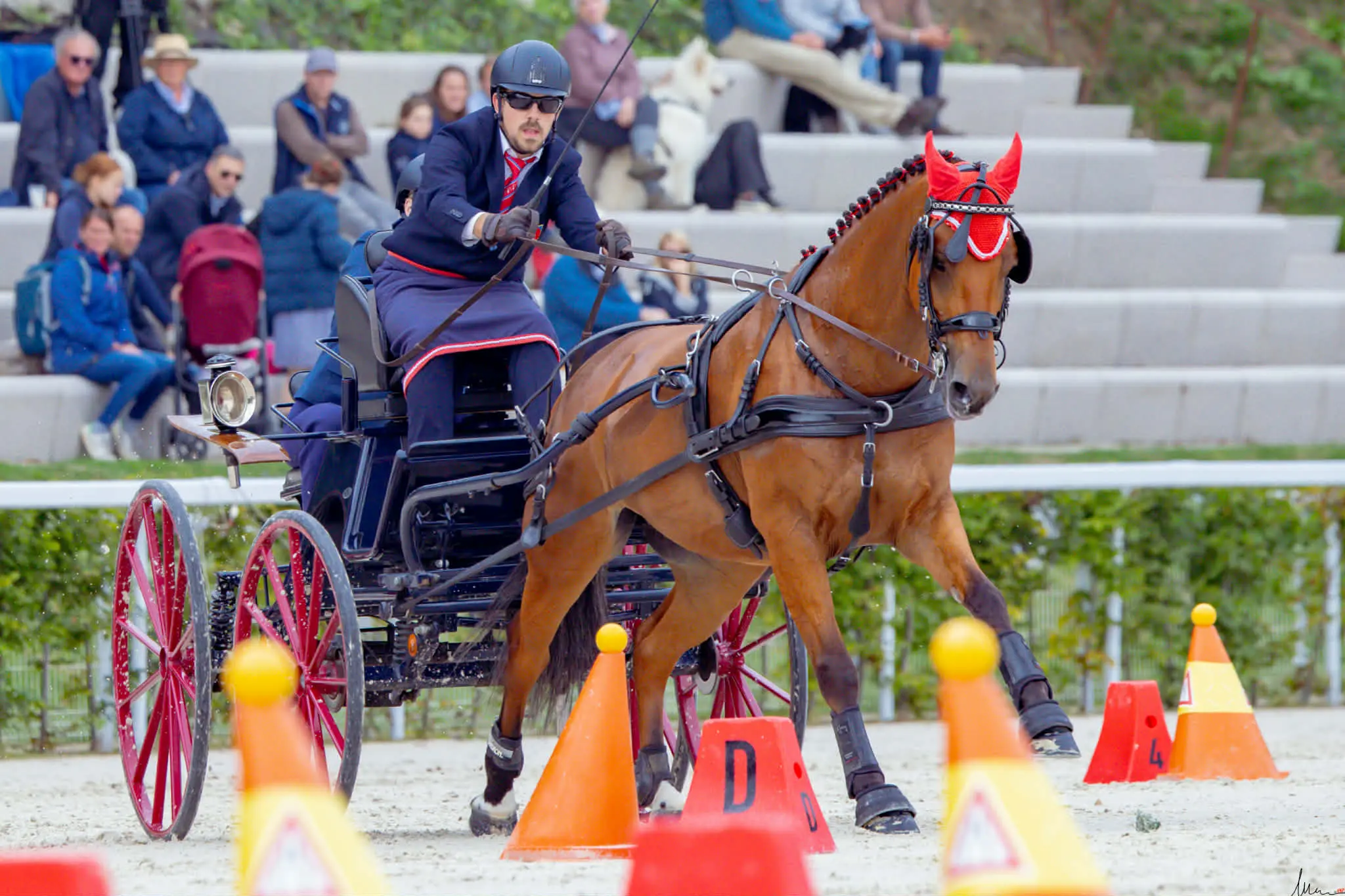
Reigning champion Mario Gandolfo (SUI) in the cones phase.
The World Singles Championship has been running every two years since 1998. European nations have dominated — Germany and the Netherlands especially — with Switzerland, Poland, and France each adding their names to the list.
Reigning champion Mario Gandolfo of Switzerland will be back to defend his title. This is the field every single-horse driver in the world measures themselves against.
Recent champions:
| Year | Location | Individual Gold | Team Gold |
|---|---|---|---|
| 2024 | Le Pin, FRA | Mario Gandolfo (SUI) | France |
| 2022 | Le Pin, FRA | Saskia Siebers (NED) | France |
| 2020 | Pau, FRA | Saskia Siebers (NED) | Netherlands |
| 2018 | Kronenberg, NED | Bartlomiej Kwiatek (POL) | Netherlands |
| 2016 | Piber-Köflach, AUT | Dieter Lauterbach (GER) | Germany |
| 2014 | Iszák, HUN | Wilbrord van den Broek (NED) | Germany |
| 2012 | Companhia das Lezírias, POR | Christoph Dieker (GER) | Germany |
| 2010 | Pratoni del Vivaro, ITA | Thorsten Zarembowicz (GER) | Germany |
The Sport

Combined driving — often called a CDE — is a three-phase competition modeled roughly after eventing. All three scores combine into a final ranking; lowest penalty total wins.
Dressage opens the competition. Horse and driver perform a memorized test in a large arena while judges score each movement from 0 to 10. It’s where training shows — or doesn’t.
Marathon — a cross-country course of seven to nine kilometers with seven obstacles built into the landscape. Each obstacle is a maze of elements constructed from timber or other materials, often using the terrain itself as part of the challenge — a ditch here, a bank there, gates set tight enough to keep things interesting.
The competitor’s job is to get in and out of those obstacles as fast as possible, because they’re being penalized for every hundredth of a second they spend inside. It’s 80% plan, 20% execution, and 100% adrenaline.
Cones closes the show — a precision course through pairs of cones set just wider than the carriage wheels. Knock a ball off: penalty. Exceed the time allowed: more penalties. It looks calm from the stands and feels anything but.
The Venue

Obstacle framework going in. The championship tents are already up in the background.
The Olympia-Reitanlage has been an active equestrian site since the 1930s, when the grounds were first built for military riding. Its defining moment came in 1972, when Munich hosted the Summer Olympics and the facility was rebuilt as the largest equestrian center in Europe — 23,000 spectators, stabling for 370 horses, ten jumping arenas, six dressage arenas, and a grandstand with a signature cantilevered wooden roof.
Over fifty years later it’s still running. The Bavarian State Heritage Office has since designated the entire grounds a protected heritage ensemble. The tree-lined paths, rolling terrain, and ornamental pond were all part of the original design — the idea was a park you happened to compete in, not a facility you happened to landscape. It shows.
Today the grounds operate year-round as a working equestrian campus: riding academies, a state riding and driving school, a breeding program, boarding, and lessons all sharing the space between major events.
On any given weekday, the place quietly does what it was built to do. Horses are worked, riders are trained, and the daily business of horse sport moves through the barns as it has for nearly a hundred years.
The BRFV also hosts the annual Pferd International München here — a multi-discipline show event considered the largest equestrian gathering in southern Germany. The venue draws major competitions year-round. This September, it steps up to host the driving world.
While You’re in Bavaria

Neuschwanstein Castle — about two hours south of Munich. Public domain.
Munich isn’t a horse town in the way Aachen or Wellington are — but Bavaria has its moments.
• The Riem horse racing track has been operating next door to the equestrian facility since 1897.
• Munich’s beer garden culture has roots in the horse era. Vendors set up near shaded underground cellars to keep their beer cold, the horses rested in the shade, and those gathering spots became permanent social institutions.
• A 17-year-old Albert Einstein once earned extra money screwing light bulbs into the ceiling of a tent at Oktoberfest. He later did other things.
• Nymphenburg Palace — the Wittelsbach royal summer residence on the western edge of the city — served as an additional equestrian venue during the 1972 Olympics. Worth visiting on its own merits.
• Neuschwanstein Castle is about two hours south of Munich in the Bavarian Alps, and it is exactly as spectacular as advertised. King Ludwig II commissioned it in 1869 as a personal retreat and homage to Richard Wagner, and it went on to inspire Disney’s Sleeping Beauty castle. It was never finished. You can still get to the castle from the village by horse-drawn carriage — which feels appropriate.
RettaRoo in Riem

This September, Retta Roo gets her chance at a bite of the World Championship apple. Loretta — aka RettaRoo — belongs to Tara Devine, who’ll be navigating while I drive.
We’ve been on the grind to make it to this event since we decided to move Loretta up to FEI 3-star in 2024. We’ve put in the scores, done the homework, and are now handling the slightly mind-boggling logistics of moving a horse, carriage, and driving team across an ocean.
We’re in the final four qualified horse/driver combinations after a season that started with hopefuls numbering in the double digits. The official roster announcement comes from the USEF at the end of July. We’ll already be training in the Netherlands — because waiting around isn’t how this campaign operates.
If you want to follow the campaign — or help make it happen — you can find us at GoRettaRoo.
More as the season unfolds.
Tickets for the 2026 FEI World Singles Driving Championship are available at brfv.de.
Follow our journey: GoRettaRoo