Roo Report – Remember What You Know
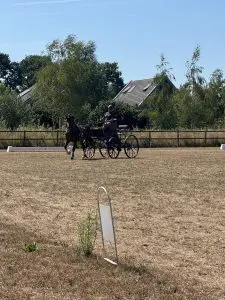
 These days, Loretta and I are training in a dressage field right on the edge of the village of Steensel, Netherlands. There’s often a steady stream of bicycles, scooters and just about any other kind of wheeled conveyance quietly passing by. Some people will stop to watch for a while.
A tiny chapel, roughly 10 by 13 feet, sits by the field, while the surviving 130-foot tower of Steensel’s medieval St. Lucia Church looks over the village from nearby, as it has since the late 1300s. It’s pretty different from training anywhere else.
It doesn’t quite feel like training for a world championship. It feels more like a learning journey, with the horses reminding you that you always have to use all of what you know.
It’s kind of a sticky wicket. If you’re in a new place, with new goals and new instructors, you want to learn new things. The trouble is, you only really earn your way into the new stuff when you’re reliably executing what you already know.
The past few weeks of training here have provided a perfect example: two concepts I’d left on the table—and how my lessons put them both back to work.
The Space Between
 When we’re practicing dressage, we have a tendency to get caught up in the specific movements of the test—a circle here, a collected trot there, a shoulder-in somewhere else. Those are the cool-kid tricks. They’re the things we want to practice, improve and talk about.
But you can’t just drive the cool parts and then take a break as you traverse the arena to where the next big thing happens. You have to drive all the parts and pieces that connect them. That working trot on the way to the next movement isn’t just there to get you from one place to another. It’s your opportunity to build the components of the next movement.
During a recent lesson, my coach pointed out that Loretta was losing power on the short side of the arena. The focus of the lesson wasn’t the corners, but her lack of power coming out of the corner was affecting her ability to be straight, balanced and poised for the next movement—in this case, a shoulder-in.
We kept working on the shoulder-in, but we were only getting a portion of what Loretta was capable of. Each time the exercise brought us around to another corner, she would back off while I was busy gathering my thoughts for the next shoulder-in. That, of course, led to my coach repeatedly telling me to get after Loretta to stay forward.
I was so focused on the coordination required for the shoulder-in that I wasn’t getting her fully ready before it. I had stopped driving the space between. The corner and short side weren’t just the commute to the next movement; they were part of the work.
Then my coach said the magic words:
“A pattern is starting to show up here.”
That exposed a second concept I had left behind.
Patterns Have Superpowers!
 A pattern is just something that repeats regularly. The cool thing about something that repeats is that you just have to observe when and where it shows up. Then you can anticipate and act upon the pattern to create the change that you want.
Rinse and repeat, and you’ve created a new pattern!
That is proactive driving—a subject I’m particularly passionate about. You always have to be driving in the next moment—acting in anticipation to create and train what you want to have happen next. While people love to talk about how important it is to “be in the moment,” the fact of the matter is, that’s a moment too late.
PROACT
- P — Patterns
- R — Repeat.
- O — Observe what is repeating.
- A — Anticipate when it will happen again.
- C — Create the response you want before it happens.
- T — Train that response through repetition.
I had observed that Loretta was repeatedly backing off in the corners, but I wasn’t acting on that information. I’d enter a corner, Loretta would back off, and then I’d re-act to her loss of energy.
I wasn’t using that repeating pattern to train what I wanted to have happen instead.
Getting Ahead of the Corner
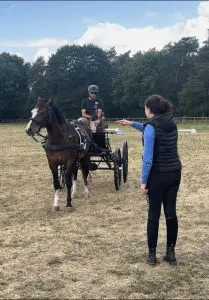 The next day, I had a choice: spend the precious little time I had with this amazing instructor hearing the same corrections, or give her something else to talk about.
From the outset of the drive, I decided that I would drive the corners proactively. Rather than waiting for Loretta to back off in the corner, I would send her forward every time we entered the short side of the arena—before she had a chance to consider backing off.
The results were dramatic—in a really good way!
For a change, I got to be the hero on the field during my lesson. Instead of having to talk about “the rubble in the corners,” we actually got to build the movements we really wanted to work on after the corner. In fact, the word “corner” was hardly mentioned during the whole lesson.
I hadn’t needed a new way to train the shoulder-in. The answer was to drive all the parts and pieces that came before it—and to drive them proactively.
That was the humbling part: Loretta didn’t need me to know more. She needed me to use what I already knew.
If you’ve been enjoying these Roo Reports and would like to help keep this adventure moving, we’d be grateful for your support.
— Andy & Retta Roo 🐴🇺🇸
Want to learn more?